
You are not thinking. You are rehearsing.
On the exhausting habit of living inside your own head, and the one thing that actually breaks the cycle.

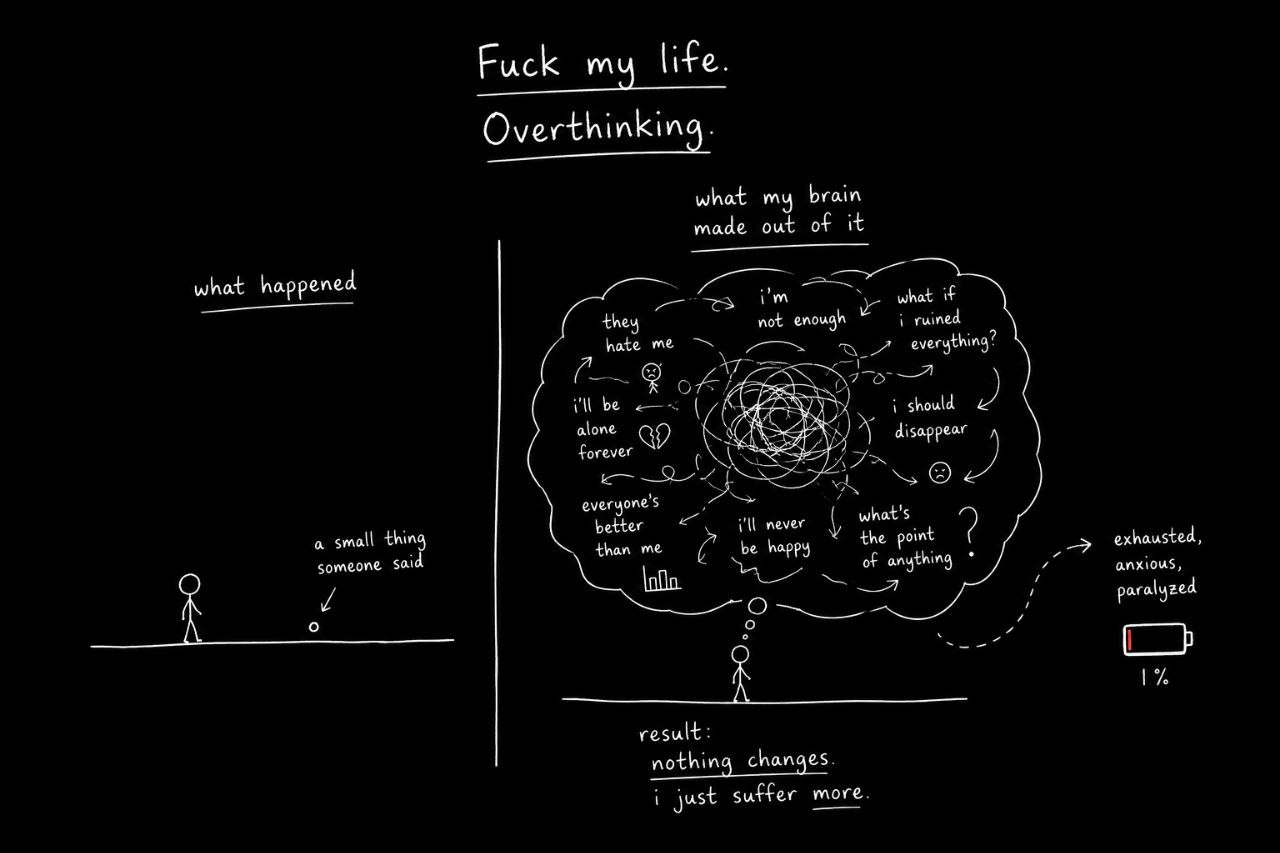
I once spent the walk home from the gym replaying a comment I’d made in a group chat. Just a joke. One of those things you fire off without thinking and immediately regret the second you see the message sitting there, read receipts on, no replies coming.
By the time I got through my front door I had already decided everyone found it annoying, written and deleted two follow-up messages trying to smooth it over, and convinced myself I had somehow damaged a friendship over a joke about a TV show.
The walk is twelve minutes.
Nobody said anything. Nobody cared. It was a joke about a TV show.
That’s the thing about overthinking that gets me every time. It feels exactly like thinking. It presents itself as careful, responsible, socially aware. And so you keep going, keep pulling the thread, keep asking what it meant and what they think and what you should do, until the original thing has been so thoroughly processed it no longer resembles reality at all.
Overthinking feels like thinking the same way spinning your wheels feels like driving. All the motion, none of the movement.
So I want to talk about what overthinking actually is, where it comes from, and what actually interrupts it. Because the usual advice, “just stop,” or “think positive,” completely misses what’s happening underneath.
PART ONE
Your brain hates open loops
Humans have a hard-wired need to finish things. Psychologists call this the Zeigarnik effect, named after a Soviet researcher named Bluma Zeigarnik who noticed in the 1920s that waiters remembered uncompleted orders far better than completed ones. The unfinished task keeps running in the background, burning processing power, demanding resolution.
Overthinking is an open loop that can’t close. You are trying to resolve something that by its nature cannot be resolved by thinking about it. The outcome of a conversation. Whether someone is annoyed with you. Whether the decision you made last year was the right one. Your brain keeps the file open because it hasn’t received a signal that the task is done. And you keep feeding it more thought, which it reads not as resolution but as continued engagement.
Profound Idea: The loop doesn’t stay open because you haven’t thought enough. It stays open because thinking was never going to close it.
There is a version of thinking that actually solves problems. You have a concrete question, you gather information, you decide, you act. The loop closes. That kind of thinking is genuinely useful. Overthinking starts when you apply that same process to questions that have no answer available yet, or questions that only reality, not thought, can answer.
Will they reply? Thinking about it for an hour will not produce an answer. Them replying will produce an answer. The information you need exists outside your head. You can’t access it by going further inside.
PART TWO
Why it feels like intelligence
I spent a long time thinking I overthought because I was self-aware. Like it was the price of caring deeply. And there’s something seductive about that story.
But I think it’s backwards.
Overthinking tends to show up most intensely around the things we feel least in control of. Social situations. Other people’s opinions. The future. Anything where the stakes feel high and the variables feel uncontrollable. The mind starts generating scenarios not because it’s particularly intelligent, but because it’s scared. It’s trying to control something through simulation that it can’t control in reality.
You don’t overthink because your mind is powerful. You overthink because your mind is frightened, and frightened minds run scenarios until something feels safe.
The philosopher William James wrote that the greatest weapon against stress is our ability to choose one thought over another. I used to find this deeply annoying. Choose differently? If I could do that, I’d already be doing it. But I think what he was pointing at is something subtler. He wasn’t saying the thoughts don’t arrive. He was saying you have more say in what happens next than you think.
The thought arrives. You didn’t send for it. That’s fine. The question is what you do in the two seconds after it arrives. Do you sit down with it, offer it tea, and start asking it questions? Or do you notice it, name it, and go do something real?
Profound Idea: A thought is weather. You didn’t make it and you can’t stop it arriving. But you decide whether to build your house in it.
PART THREE
What actually breaks the cycle
About a year ago I started paying attention to what actually interrupted my own loops, not what I wished interrupted them, not what sounds good in theory. Just what worked when I was in it.
It was almost never another thought.
It was physical reality. A cold shower. Running until I had to think about breathing. Cooking something that needed actual attention. Calling a friend and saying the loop out loud, which immediately made it sound absurd. Writing the catastrophe down on paper in full, where it had to become specific instead of staying vague and enormous in my head.
What these share is that they close the loop through experience rather than analysis. The brain stops rehearsing when you give it something real to do. Not because the problem is solved. Often the problem isn’t solved at all. But the brain receives a signal: we’ve moved. We’re doing something. You can stop running the simulation.
Reality interrupts rehearsal. And the body is the fastest route back to reality.
There’s also something harder to sit with. A lot of what we overthink genuinely doesn’t require a decision. We think it does. We’ve convinced ourselves that if we just figure out the right answer, we can pre-empt the discomfort of not knowing. But most of life resolves itself through time and action. You were never going to think your way to certainty. The certainty was always going to come from doing the thing and seeing what happened.
THE PRACTICE
Four things that actually work
01. Name the loop the second it starts. Not after an hour. The moment you feel it beginning, say it out loud or write it down: “I’m in the loop again.” Something shifts the instant you observe the thought instead of becoming it. You go from being the car to being the driver. You can’t steer something you don’t know you’re inside.
02. Write the worst version of it, completely. Most overthinking circles a disaster without ever landing on it. You get close, it frightens you, you pull back, you circle again. Write out the actual worst case. Be specific. Not “things go badly” but exactly what that looks like, step by step. Then ask yourself one question: could I survive this? The answer, almost always, is yes. The fear lives in the vague. Specificity kills it.
03. Move your body before your next thought. When you notice the loop, stand up and move before you think about it. Walk. Do pushups. Make tea with real attention on the kettle. The goal isn’t exercise. The goal is to give the brain something with immediate physical feedback. Thinking has no feedback. Movement has constant feedback. The nervous system starts calming the second you’re doing something that requires a body.
04. Set a worry window and keep it small. Give yourself fifteen minutes, at a specific time, to think about the thing fully. Outside that window, when the thought arrives, you tell it: not now, we have a time for you. This converts the loop from an ambient all-day presence into a bounded, scheduled event. You stop white-knuckling the thought away, which never works anyway. You just defer it to somewhere it can’t colonise your whole day.
One last thing before I let you go.
If you’re an overthinker, you probably already know you are. You’ve known for a long time. And you’ve probably felt some shame about it, like it’s a weakness, like you should just be able to calm down. I don’t think it’s a weakness. I think it’s what happens to a mind that cares too much about getting things right in a world that rarely gives clean answers.
The problem isn’t the caring. The problem is pointing the caring at simulation instead of action. At rehearsal instead of the show.
You’ve rehearsed enough. You already know the lines. Go do the thing.
More next week.
— Aaron
A nice little read just before bed after a night shift 😌 ... I always find it tough in the moment to catch yourself overthinking. You're so caught up in the story that it can sometimes consume you. I'll strive to continue to practice, thanks for the practical advice 🫶